Last reviewed: July 2026
You have probably read a few sites today, and each one gave you a slightly different list. That is the part that makes this stressful. Here is the plain version, the way we would explain it to you on a call.
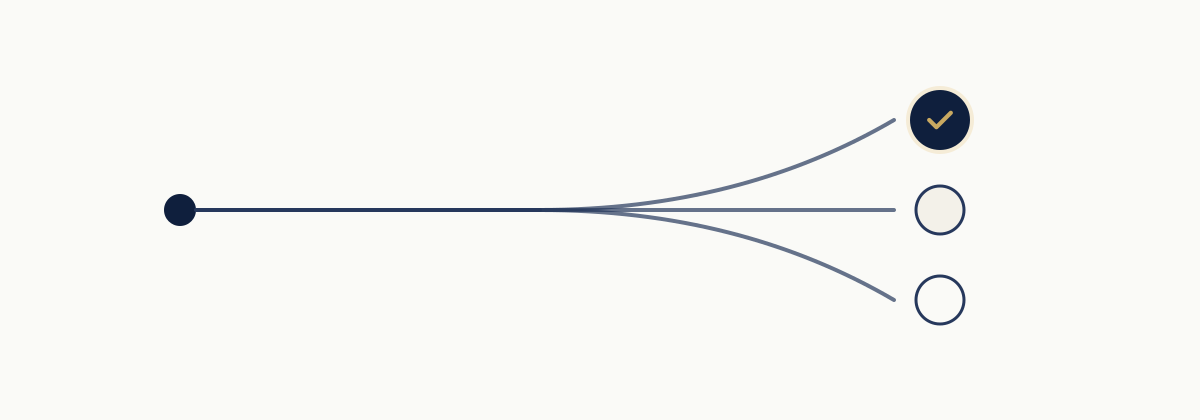
The 30% ruling (becoming 27% from 2027) has a small set of core conditions, a few exceptions that catch people off guard, and a large grey area in between. Most of our work lives in that grey area.
The core conditions
For a standard application, you generally need all of these to be true:
- You were hired from outside the Netherlands. The recruitment has to start abroad.
- You meet the salary threshold for your situation (it is indexed each year).
- You meet the 150 km rule: you lived more than 150 km from the Dutch border for at least 16 of the 24 months before your first working day.
- Your employer is a Dutch withholding agent.
- You apply within 4 months of your start date to get the full benefit from day one.
If every line is a clean yes, you are likely in the straightforward lane.
The exceptions that catch people out
Plenty of people who think they are excluded actually qualify through an exception:
- Graduates of a Dutch master's program, if employment starts soon after graduation. The 150 km rule is set aside, and the threshold is lower for under-30s with a master's. More on this in the graduate guide.
- Scientific researchers and PhD candidates at designated institutions, who can fall outside the usual salary threshold.
- People who held the ruling before and are returning, where specific lookback rules apply.
The grey area (where most people actually sit)
Real situations are rarely a clean yes or no. These are the patterns we see most often:
- You lived or studied in the Netherlands before your hire, so the Belastingdienst questions your ties.
- You had a gap of several months between graduating and starting work.
- You had freelance income or a KvK registration during your studies.
- Your residence here was on a partner's permit, or on something other than a standard highly-skilled-migrant route, which can make the "recruited from abroad" picture less obvious.
None of these end the conversation. They mean your case has to be prepared and argued, not just submitted. That is the difference between a form and an application.
A note on 2027
From January 2027, the 30% ruling becomes the 27% ruling for anyone who started benefiting from 2024 onward. Existing higher rates are protected for the years before 2027.
So the change does not undo your eligibility. It changes the percentage for newer arrivals from 2027.
How we can help
If your case is clear-cut, we will tell you. If it sits in the grey area, that is exactly the work we take on, and you get an honest read before you spend anything.
15-Minute Call
Free
A short call to talk your situation through. Best for relatively straightforward cases or quick orienting questions.
Expert Check
€99
A written assessment of your case in 2 to 3 business days. Best when you want clarity before committing to anything.
Application Service
Best value€549
We build, draft and submit the full dossier for you. Best when you are ready to apply. 3 weeks from kickoff to submission.
Not sure which lane you are in? Start here.
We don’t predict outcomes. We prepare and present your application in the strongest possible way. Belastingdienst makes the final decision.